Businesses in Bashundhara, Dhaka, can benefit from professional VAT lawyers and consultants to manage tax obligations efficiently. VAT consultancy and compliance support help businesses maintain accurate records, submit VAT returns on time, complete BIN registration, and handle VAT audits and notices under Bangladesh VAT law. With expert guidance, businesses can reduce compliance errors and avoid costly disputes while focusing on daily operations, customer relationships, and financial management.
VAT Support Services at HASANAC help businesses understand their VAT obligations, including what needs to be done, where to complete the required procedures, and how to comply with applicable regulations. From VAT return preparation and BIN registration to audit support and VAT notice assistance, we provide guidance tailored to business needs. Contact HASANAC to discuss your VAT requirements and find the right support for your business.
HASAN Associates & Consultancy (HAC), provides VAT consultancy and compliance support to businesses in Bangladesh. Its services focus on helping businesses understand their VAT obligations, organize documentation, manage registration requirements, prepare VAT returns, and address VAT-related notices, assessments, and disputes. The specific support required depends on the business's activities, transaction history, compliance status, and the applicable VAT laws and regulations.
Bashundhara businesses operate in retail, hospitality, real estate, professional services, and other commercial sectors. Firms may operate differently, but they share a common responsibility: understanding how VAT rules apply to their operations.
Suppose a business records its sales appropriately but does not properly record its purchases. The accounting records may seem comprehensive, but the missing documents could cause complications when trying to justify input tax adjustments or when responding to an audit.
Likewise, submitting a return without reconciling the underlying information might enable modest disparities to carry forward from one tax period to the next.
Professional VAT support allows companies to make their procedures more uniform. Rather than waiting for a problem to arise and then reacting, owners can analyze their records on a regular basis and solve problems while the information is at hand.
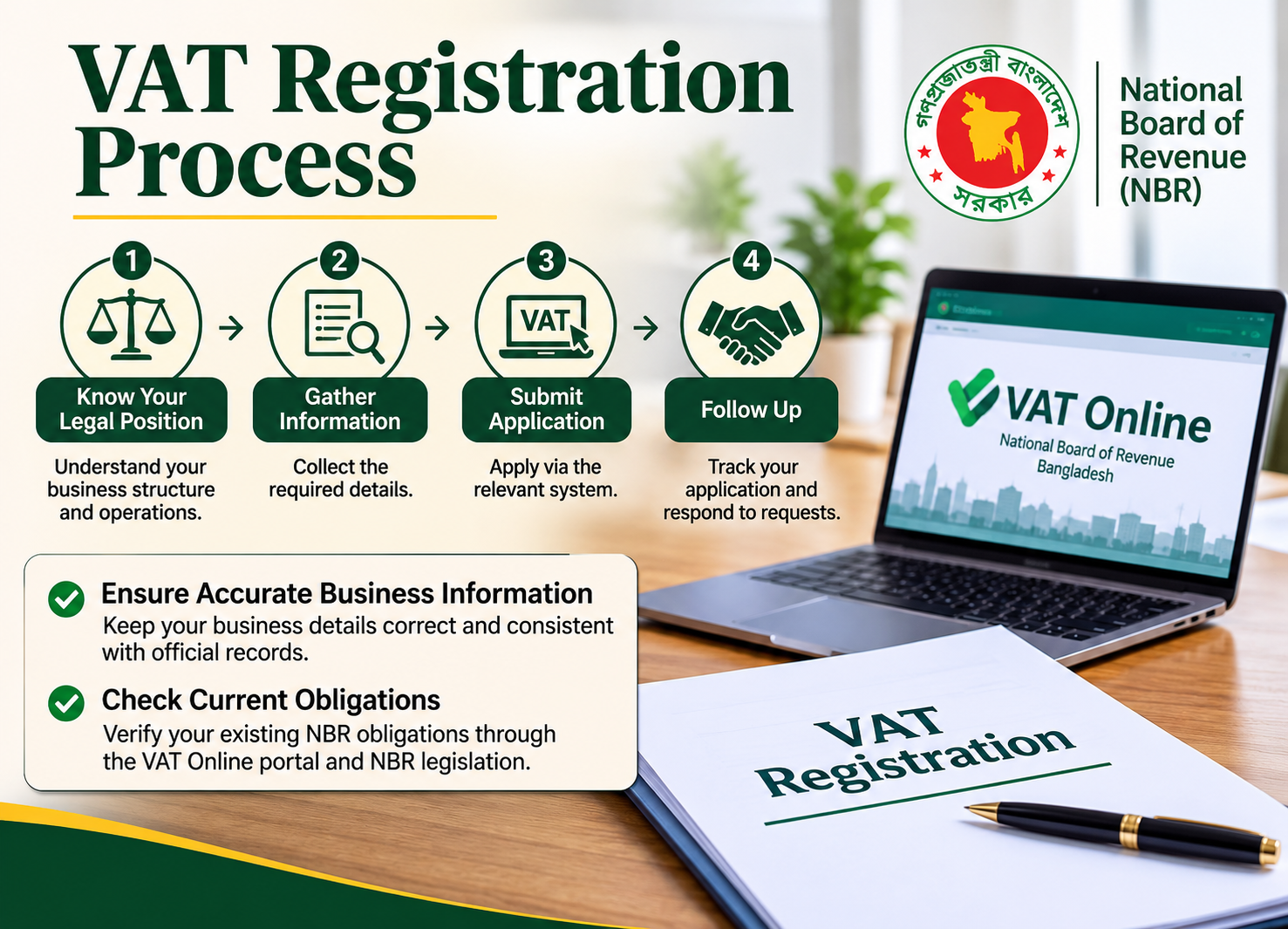
Before registering for VAT, you need to know the firm’s legal position. Usually, you go through the business structure and operations, determine the registration needed, gather the information, and submit the application via the relevant system.
Once filed, the business should follow up on the application and respond to requests for further information as necessary.
Business information is required to be accurate and consistent with the records to support it. Incorrect business details may cause administrative issues soon, including updating registration details or submitting returns.
It is also advised that they verify what their current NBR obligations are through the VAT Online portal and their NBR legislation.
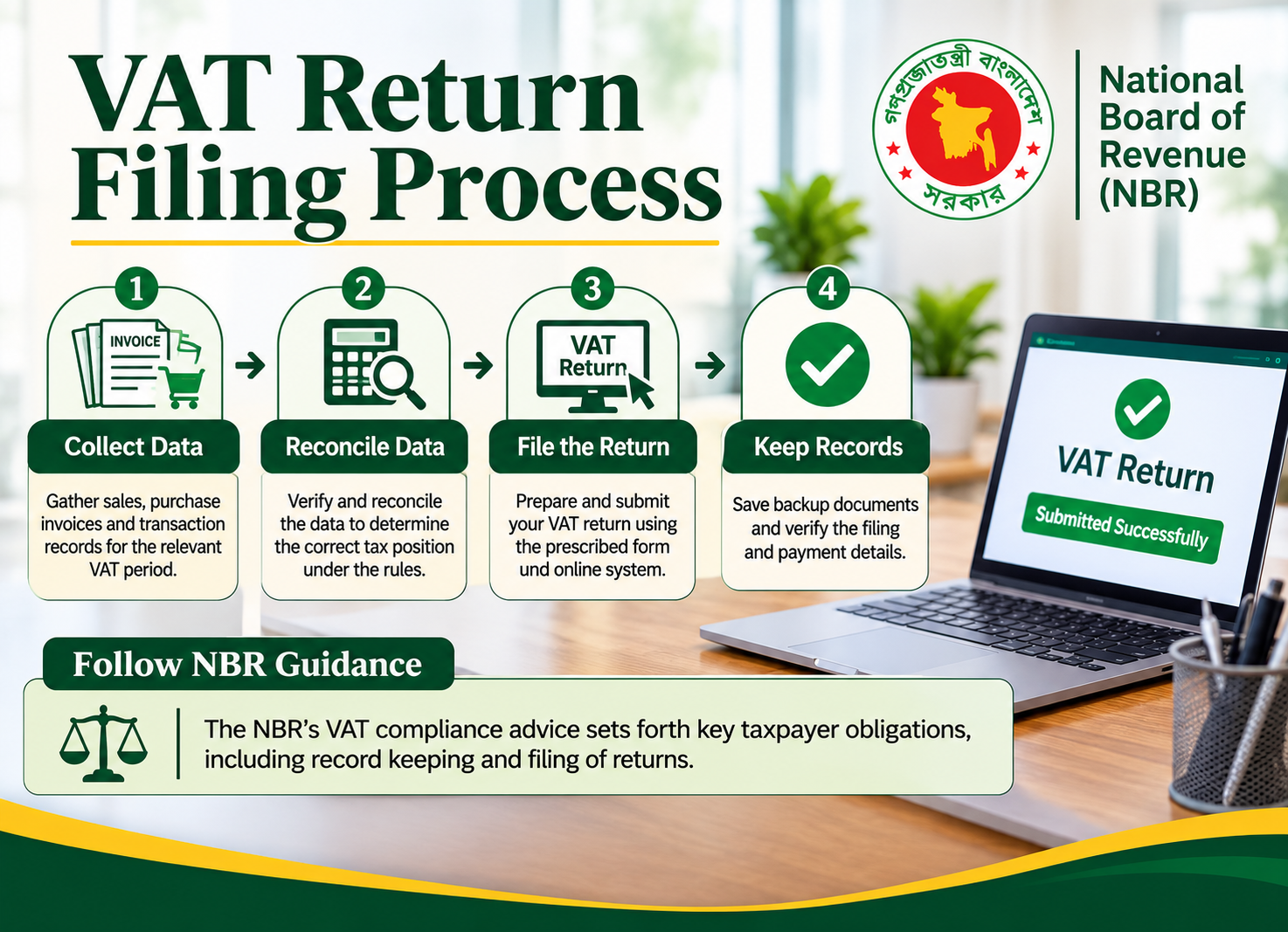
The process of VAT return filing begins by collating strong transactional data for a particular tax period. Normally these documents contain sales, buy invoices and modifications related to the transactions and VAT payments.
The next stage is to reconcile the data and work out what the appropriate tax position is under the applicable rules. Any differences should be checked before the return is filed.
Once the information has been checked, the return can be produced and filed using the correct system and prescribed form. Companies should save backup documentation and check that the filing and payment info was entered correctly.
The NBR’s VAT compliance advice sets forth key taxpayer obligations, including record keeping and filing of returns.
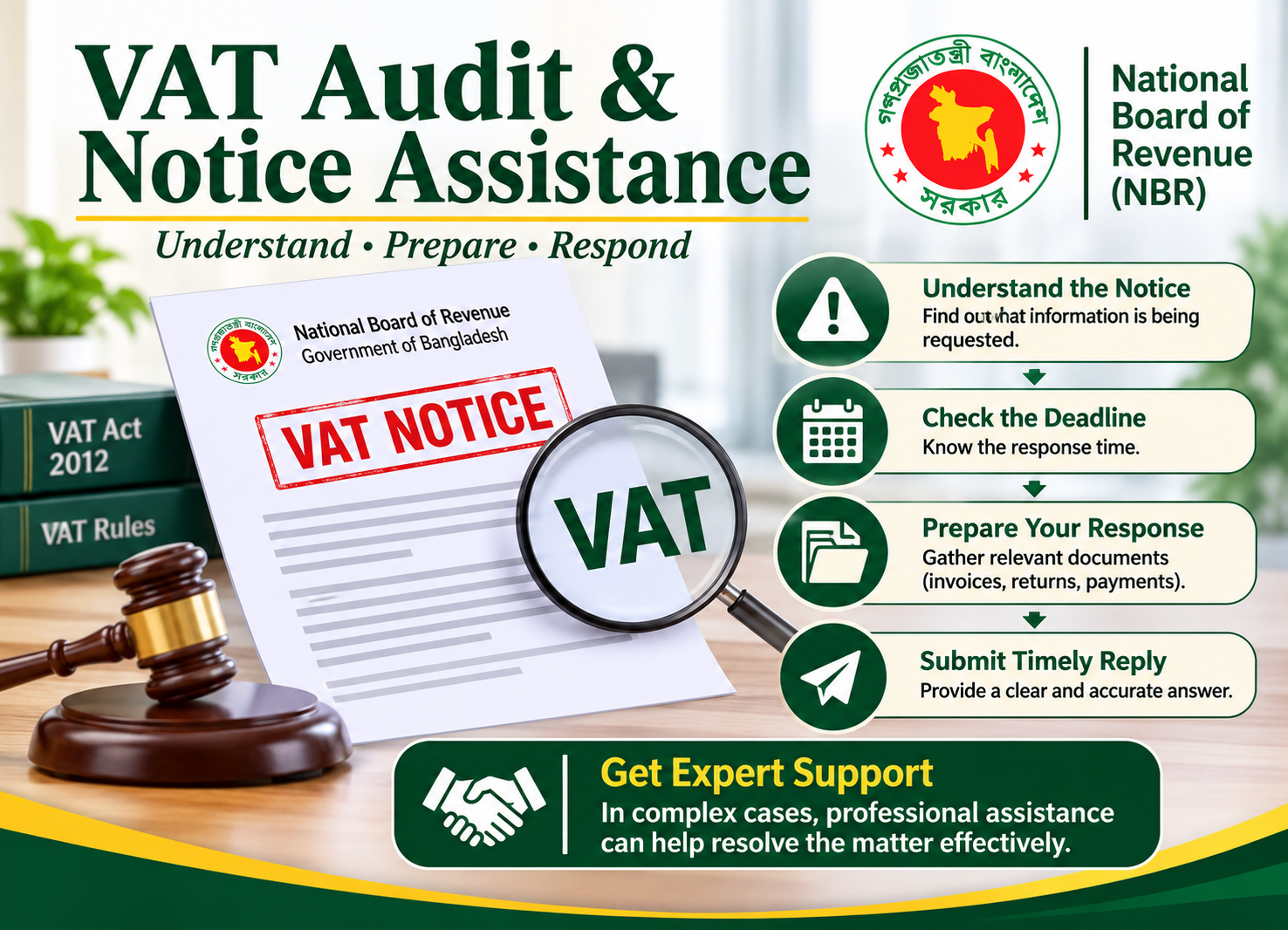
A VAT notice does not mean that a business has necessarily committed an offense. The notice may ask for clarification, supporting documentation, payment information or explanation of a specific transaction.
What you say back depends on what’s in the notice, what documents you have and the legal basis of the matter.
Businesses should first determine what information is being asked for and the deadline for responding. They should next collect the appropriate invoices, returns, payment history and communications and prepare their answer.
Ignoring the notice or providing an inadequate answer could make the situation harder to resolve. In complex situations, expert aid can help the firm grasp the problem and produce a properly documented solution.
An assessment, a decision of the VAT authority or a disagreement on the treatment of individual transactions might give rise to a VAT dispute.
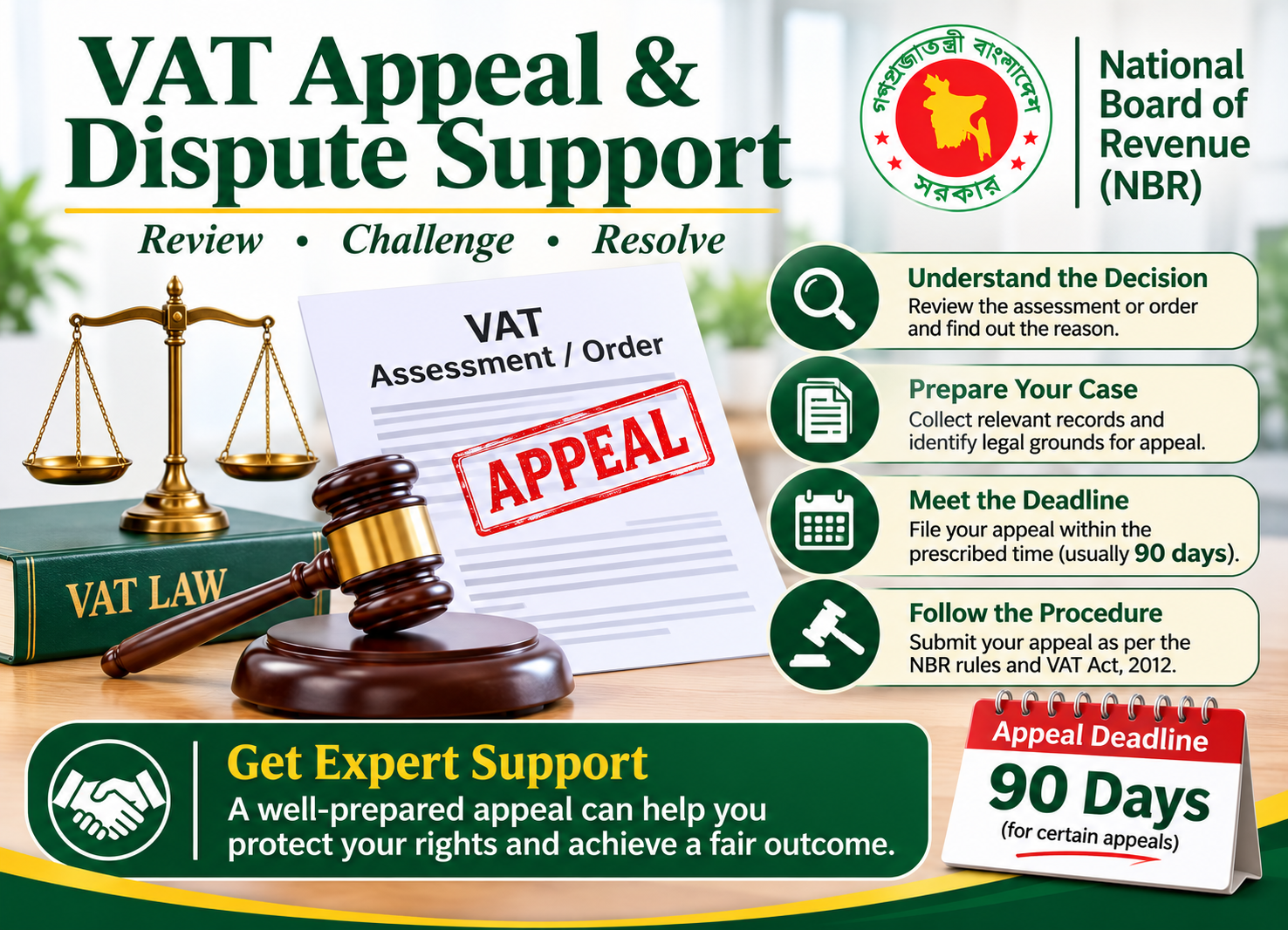
The first thing to do is to look at the order and see why that conclusion was made. The business can then look at relevant records, look for possible grounds for challenge and determine the correct legal approach.
Time limitations are especially crucial. The NBR’s published VAT FAQs describe appeal mechanisms under the VAT and Supplementary Duty Act, 2012, including a general 90-day deadline for certain appeals. Check the order and current law for the applicable deadline and procedure.
You may find further information in the NBR’s official guidance on VAT appeals for businesses.
A properly prepared dispute is based on precise records, a straightforward statement of the disagreement, and careful adherence to procedural requirements.
Choosing VAT support involves more than just a service comparison. Businesses need to understand the help they require, the documents needed, and what the engagement would entail. The HASANAC team solves VAT issues on the basis of documentation, procedural transparency, and knowledge of the corporate position.
In our opinion, it is vital to first describe the problem and then propose the remedy. This gives business owners insight into their responsibilities, instead of them making assumptions about how VAT rules apply.
We also know that normal compliance and formal conflicts are different things, needing different approaches. An appeal can require a comprehensive review of the decision concerned and the relevant laws. The application for registration would have to be accurate with information and the right documentation.
If you are a business looking for a VAT Consultant in Bashundhara, you need to look for a support system that communicates effectively, manages records with care, and explains not just the options but the limitations of the same.
You can find a VAT lawyer in Bashundhara, Dhaka, through professional referrals or legal directories. HASANAC can help you understand your VAT obligations, assess compliance issues, and access appropriate tax support.
A VAT lawyer offers advice to companies on their VAT liabilities, examines assessments, addresses notices, and considers available remedies. The extent of the legal advice will vary per the issue and the expertise of the VAT lawyer.
Registration requirements will differ based on the relevant turnover thresholds, business types, and legal requirements. Different businesses must consider each of their contexts by reference to NBR regulations as they currently stand.
Yes. A VAT expert can collect transaction records, check proper calculations, draw up return information and identify problems. The firm is responsible for the accuracy of the data given and its filing commitments.
Read the notice, make note of the information required and the deadline, and obtain the records. If you do not understand the problem, or if the problem is disputed, ask before posting a reply.
Yes, HASANAC can assist businesses responding to NBR VAT notices by reviewing relevant documents, assessing compliance issues, and guiding them through appropriate responses and dispute resolution procedures in accordance with applicable VAT regulations.
Ka-11/2A, Level - 5, Bashundhara R/A & Main Road, Dhaka - 1229, Bangladesh.
+880- 2 - 8415551
+880-1711-824425
hasan07legal@gmail.com
advocatehasan@hasanac.com
www.hasanac.com
WhatsApp us